- ARTiculate
- Posts
- Building The World You Want To See
Building The World You Want To See

Saziso Phiri
February 02, 2026
Support ARTiculate for as little as the price of a coffee
This newsletter is FREE for all subscribers and will be for as long as possible. However, if you'd like to support through a donation, you can donate as little as the price of a coffee via Ko-fi or PayPal, either a one-off, or regularly. Donations go towards running this newsletter efficiently and in an engaging way, which includes some minor costs, as well as supplementing my time.
Thank you to all of you that support, whether its through donations, being a subscriber, reading, sharing your feedback with me, or/and sharing the newsletter with others.
In last week’s newsletter, I mentioned that I would be starting a new series of recorded conversations with artists whose practices are diverse, giving them more opportunity to live sustainably and fully as creatives. This series is a follow-on from last year’s Double Shift series, which focused on artists who have more than one job—some of which are completely outside of the arts. Both last year’s series and this new one are really about shining a light on the realities of living a sustainable creative life, and highlighting that there is no single way to be an artist. Being an artist is not only what is made in the studio, or displayed on the walls of a gallery or the home of a collector. It extends to so much more, beyond the silo of this thing called “the art world.”
As hinted last week, there was a likelihood the series would not be ready for this week, and it is so. I’ll be arranging and recording interviews with artists working across visual art, theatre, dance and music. In the meantime, I wanted to keep the conversation going about diverse practices by highlighting two artists who work across mediums.
Building The World You Want To See
What if the worlds you imagine could actually exist? What if you worked more outside of the traditional expectations of institutions? This weekend, I pulled out two of the following books: If It Don’t Exist, Build It by Larry Achiampong, and emajendat by Lauren Halsey. Flicking through them reminded me why I love the work of, and rave about these artists so much—and why they are relevant references for other creatives wanting to get something meaningful out into the world unapologetically through their own unique lens. For me, both artists share a commitment to world-building, but not just in the fictional sense, but by being committed to creating and supporting expansive, real-life systems, communities, and spaces that extend far beyond the traditional presentation of art. Their role of an artist fits into a duty and calling. They are bold enough to imagine what’s missing, then build it.
Larry Achiampong’s work spans sound, performance, moving image, and sculpture. Drawing on Pan-Africanism, histories of migration, colonialism, and Black British identity, he constructs immersive experiences through his art. He also strongly advocates for artists’ rights, fair pay, and ethical treatment, showing that making work and challenging systems can go hand in hand.
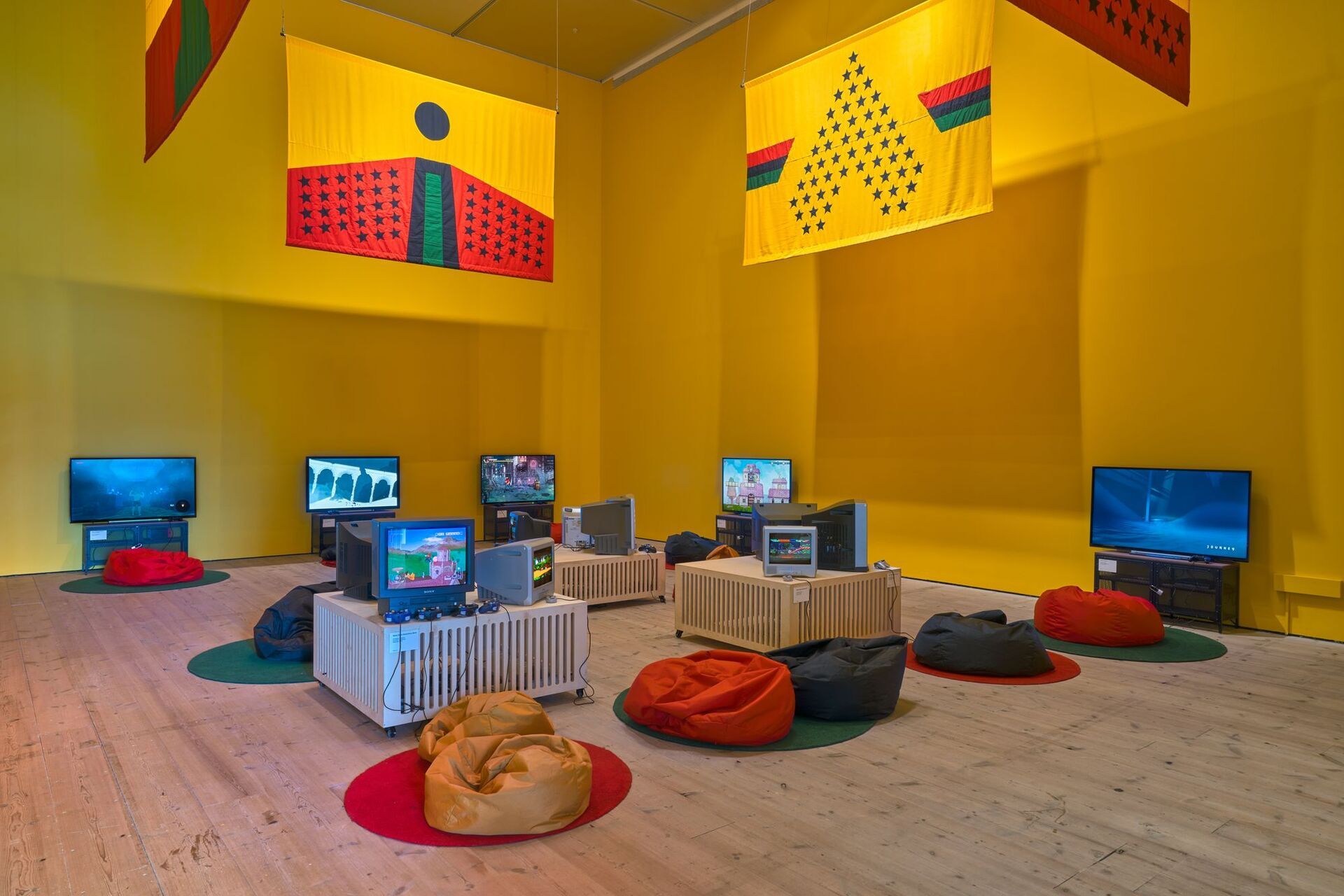
Installation view of Gaming Room for Wayfinder by Larry Achiampong at BALTIC (2023). Credit: Reece Straw
“This is one of the mantras that I say to myself: If it doesn’t exist, build it.”
Since the book came out last year, I have been sure to remind myself of the ethos of “if it don’t exist, build it”, and remind myself, that as artists we have the power and gift to create. To actually create! Think about it, to create something is to bring something into existence. To make something new. We’re versed in experimentation, and taking risks, being bold, and and being able to be part of, and navigate multiple spaces and communities. Considering this, here are three things we can learn from Larry:
If the work you need doesn’t exist, create it yourself.
Combine advocacy and art.
Use multiple media to communicate your ideas—the format doesn’t limit your ambition (hopefully we can delve into this more through the upcoming artist interview series with artists working across different mediums)
Lauren Halsey’s work is rooted in South Central Los Angeles. Across installation, sculpture, and two-dimensional works, she draws from local architecture, visual culture, and social histories. Her practice reshapes how a place is seen and valued, celebrating Black life and cultural abundance.
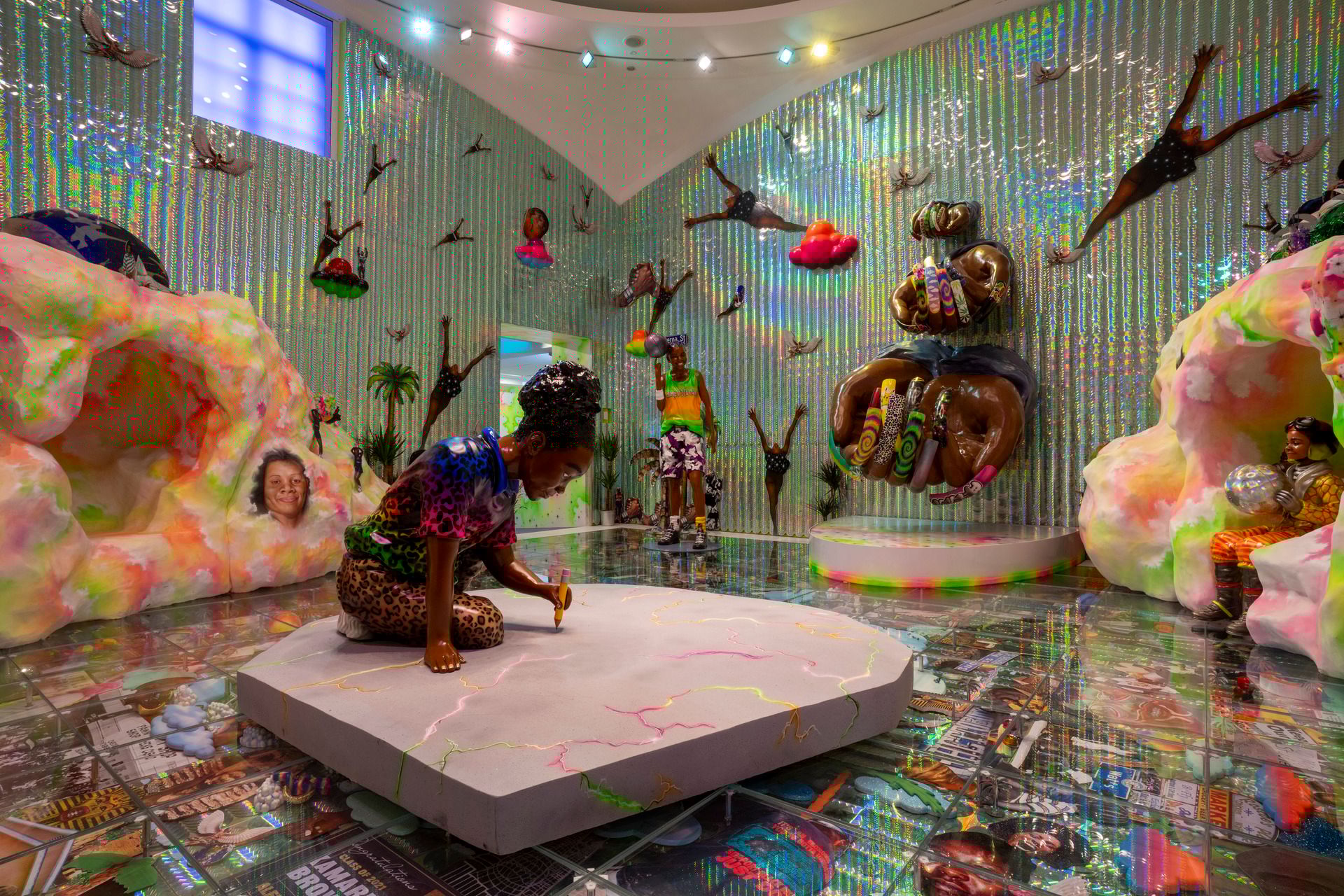
Installation view of emajendat by Lauren Halsey at Serpentine Gallery (2024) Credit: Hugo Glendinning
“What if I used art to communicate alternative messaging… especially concerning their perception of Black and Brown people? And, bigger than that, how could I use art to explore and honor the different ways these Black and Brown communities imagine and experience our neighbourhoods, lived histories and physical environments?”
From her installations to the Summaeverythang Community Center that she is establishing, Halsey shows that world-building includes tangible structures, resources, and programming—in addition to the artworks displayed at institutions, biennials and the homes of collectors. Her practice teaches:
The strongest work responds to lived experience.
What infrastructure, spaces, or systems could your art create?
Your work can rewrite narratives and assert value where it’s been denied.
Achiampong and Halsey show us that an artistic practice doesn’t have to fit neatly into a category. Visual art, advocacy, spatial design, cultural preservation, community building—they can all coexist in one practice. Your work can extend beyond galleries, institutions, and traditional expectations.
What is something you want to bring into existence? Sketch it, sculpt it, code it, perform it—whatever medium helps you make it real. Don’t wait for validation. Start now. It’s in you for a reason.
The future is not something we wait for. It is something we actively build whilst still in the present. Go for it.
If you’ve made it to this part—thank you for reading! I hope there’s something in here that resonates or encourages you to keep going.
And if you know someone who might benefit from these newsletters or sessions, feel free to forward this on and encourage them to subscribe.
Reply