- ARTiculate
- Posts
- You Need To FAIL
You Need To FAIL
Sending this week’s post a day early 😉

Saziso Phiri
January 18, 2026
Support ARTiculate for as little as the price of a coffee
This is a reader supported newsletter. If you'd like to support through a donation, you can donate as little as the price of a coffee via Ko-fi or PayPal. Thank you to those who support this newsletter financially, through one-off and regular donations. Your support means so much.
And thank you to those who approach me in public, whether at an art fair, exhibition, in passing on the street, or as of recent, in Tesco, to let me know you read the newsletter, and to express your feedback. No words to describe how wonderful and motivating these actions are 🫶🏾 I really appreciate it.
You Need To FAIL
The word failure has been coming up a lot in my thoughts recently. I also hear the word often, from my personal trainer. Towards the end of a weight-training set, they’ll say, “Let’s go to failure,” meaning the point at which my muscles can no longer complete a a full repeatition. That moment is the end—for that set or the session. It signals completion, showing I’ve reached my limit for that time, and not to overdo it. It’s also the cue that my body needs to rest, repair, strengthen, before I go again (and hopefully when I go again, I will be stronger, and be able to lift heavier).
When you try something new—a technique, a material, an idea—it often doesn’t work as imagined. The results can feel frustrating. Sometimes you are just not good at it yet, but hey, sometimes we have to be bad before we can be good, and we shouldn’t see it as defeat, but rather the beginning of learning or part of a journey of progress. In studio practice, this can look like work that won’t resolve, materials that don’t behave, or ideas that collapse halfway through. Or you know, something about the work that is not quite clicking. There’s a gap between what you sense conceptually and what your hands can execute. That gap can feel uncomfortable or embarrassing—but it’s where learning happens. Repetition, persistence, and patience turn inexperience into fluency. What once was failure starts to function. The practice builds capacity.
"I love failure. When an object doesn’t allow for failure is when we become less interested in it."

📸 Rashid Johnson taken by Joshua Woods. Courtesy of the artist and Hauser & Wirth
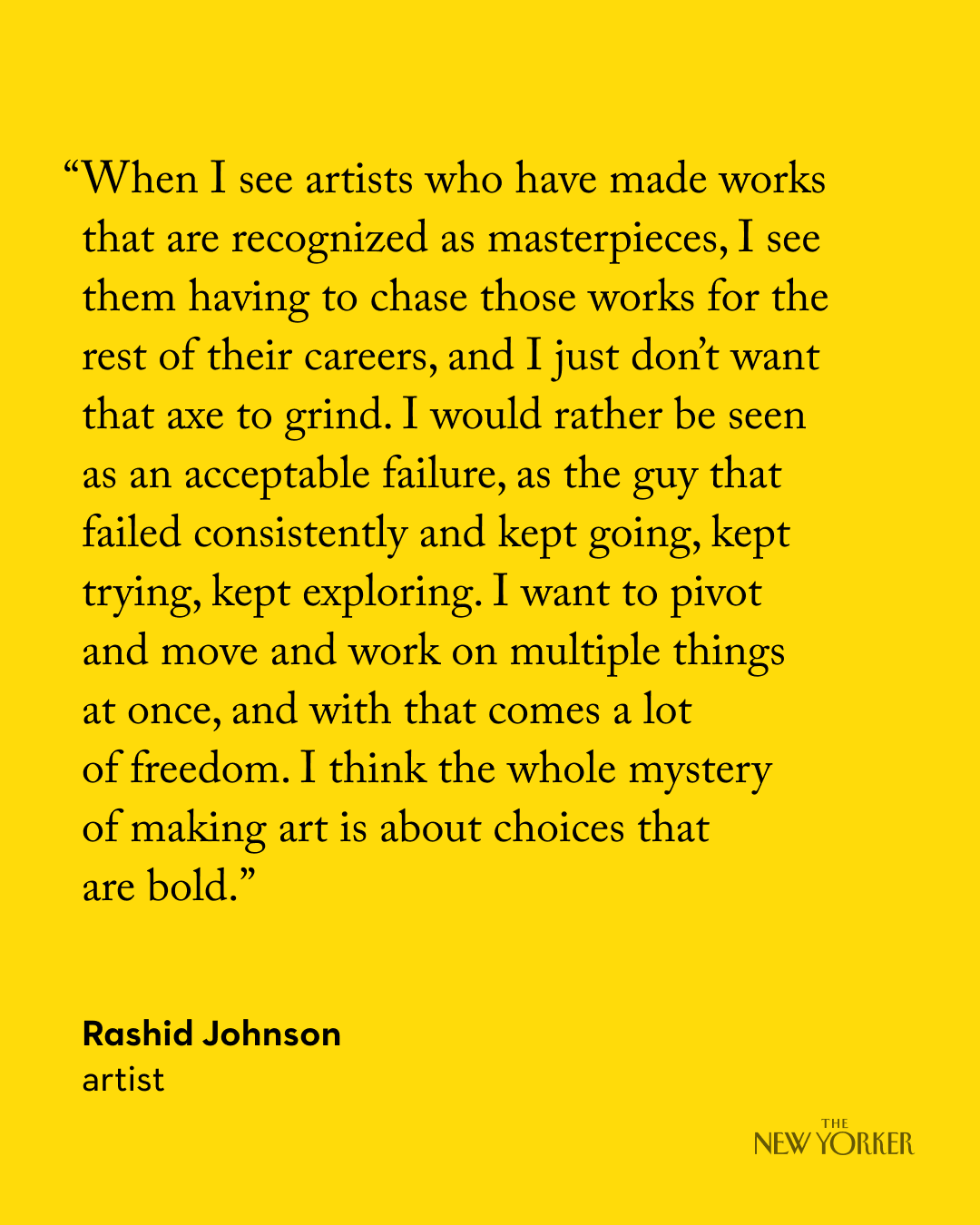
An artist who has spoken about failure quite a bit is Rashid Johnson. I love this quote above from this interview. He highlights that failure is also necessary to keep the fire burning when it comes to interest.
I haven’t practised as an artist in years, and I don’t consider myself one now. But looking back to my art college days, I can see how often fear of failure held me back. I didn’t experiment as much as I could have because I was worried about what people would think if I didn’t do something right. I was also a much slower learner than my peers. In a photography class, during a darkroom session, I exposed my film too early, and my photography tutor was quick to point that out in front of the whole class. I was embarrassed, and my confidence took a hit.” But that experience, and others like it were necessary steps in learning.
Later, when I started working in arts away from practicing as an artist, I had to do a lot alone. Often not having the support or the resources to train formally meant learning on the go, and sharing work before it was ready. And making mistakes publicly. Some of that still makes me cringe when I look back, but that exposure forced growth—just like in weight training, when the last repetitions of a set. The tension and struggle at the end (that also humbles you)—the “failure”—is exactly what allows muscles to grow. They can’t strengthen without reaching that point. Similarly, our skills, confidence, and understanding as artists develop when we push ourselves to the limits of what we can do, make mistakes, and reflect on the process. Also, thinking about training, when we are used to the same level, and live within comfort, we may get some results, or perhaps some sustainability. But will there be new growth? Will you get to the next level? You know, the place you really want to get to? Like in weight training, artistic practice is cumulative. Each “failure” builds strength, insight, and skill. Pauses and reflection—the artistic equivalent of rest days—allow lessons to settle, progress to be acknowledged, and energy to rebuild for the next challenge. Reflection ensures you don’t overdo it, and keeps the next push productive and informed.
So for you who want to come out of your comfort zone a little bit more this year:
Start now.
Start before you know all the answers., because starting is probably is what is going to lead you to them. Whether it’s a new body of work, a shift in medium, a proposal, a or a change in how you work professionally—begin with what you have.
Then work to your current limit.
Expect resistance. Expect moments of failure. Then pause. Reflect. Rest. Celebrate what you’ve progressed in, no matter how small or big. Then return to the work, stronger, more informed, and ready for the next challenge. Rinse and repeat.
Maybe, in this context, we can consider the only real failure waiting indefinitely for the “right time.” Most of the time, it doesn’t arrive. You have to build that time by starting. And to finish, can we take a leaf out of the books of those working in tech. More or not afraid to fail publicly. And we art people shouldn’t too (taking note for myself).
Go and look back at your earlier works of art or first projects. Even as far back as art school if you went, or even earlier (your childhood drawings). Then look at some of your most recent works.
Done it? Ok, so, what are your thoughts? Curious me would love to hear your thoughts. Let me know at [email protected].
If you’ve made it to this part—thank you for reading! I hope there’s something in here that resonates or encourages you to keep going.
And if you know someone who might benefit from these newsletters or sessions, feel free to forward this on and encourage them to subscribe.
Reply